
The biggest marketing challenge facing brands right now is not AI. It is the lack of brand clarity that AI is exposing.
Over the past year, many organizations have increased content production in response to AI-driven search and the rise of generative engine optimization (GEO). They are publishing more blogs, creating more landing pages, expanding social content, and trying to improve visibility across platforms like Google, ChatGPT, Gemini, and LinkedIn.
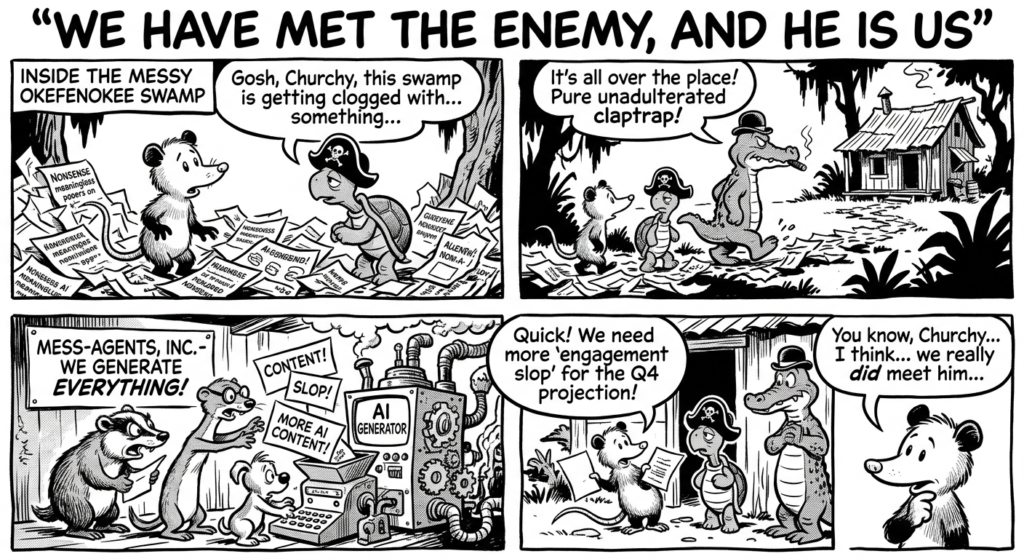
The problem is that many brands are scaling messaging and brand creative that were already inconsistent. AI is not creating that issue. It is amplifying it.
AI Is Changing Discovery Faster Than Most Brands Are Adapting
Search behaviour has changed dramatically.
Customers no longer move through a clean, linear buying journey. AI-powered search has compressed discovery, research, and evaluation into a single interaction.
Today, users ask AI platforms highly specific questions that include:
- goals
- budget
- preferences
- pain points
AI systems then synthesize answers instantly.
That changes how brands are evaluated.
Businesses are no longer competing only on rankings or keywords. They are competing on how clearly they communicate their value.
If a company cannot consistently explain:
- what it does
- who it helps
- what problems it solves
- why its perspective matters
AI systems will struggle to interpret the brand accurately. Customers will too.
More Content Does Not Fix Weak Positioning
Many marketing teams are responding to AI visibility pressure by increasing output. In some organizations, content production has quietly become the strategy.
The logic is understandable. More content should create more discoverability. More opportunities to be discovered should create more leads.
But many brands are publishing disconnected material without a clear narrative behind it.
One page positions the company as a premium. Another emphasizes affordability. One article targets enterprise buyers while another sounds consumer focused.
Messaging changes depending on:
- who wrote the content
- which department reviewed it
- which AI tool generated the first draft
Over time, the brand becomes harder to define.
This creates visibility issues across SEO, GEO, and AI search.
Modern discovery systems rely heavily on:
- consistency
- semantic relationships
- topical authority
- message alignment
AI systems are not just scanning for keywords. They are interpreting patterns across a brand’s entire digital footprint.
When those signals conflict, visibility weakens.
AI Slop Is Usually a Positioning Problem
“AI slop” has become a popular term for low-quality AI-generated content flooding the internet.
The issue is rarely the technology itself. It is usually weak editorial direction and unclear positioning.
AI tools can improve workflows, support ideation, and help teams scale content production more efficiently.
Problems emerge when brands use AI to produce content without:
- a clear point of view
- defined market positioning
- editorial standards
- consistent messaging
The result is generic content that repeats the same industry talking points as everyone else.
No differentiation. No authority. No memorable perspective.
This creates long-term risks:
- Brand messaging becomes interchangeable with competitors
- Topical authority weakens
- AI-generated answers become less likely to reference the brand
- Search visibility becomes inconsistent
- Customers struggle to understand why the company matters
In many cases, organizations are creating more digital noise while believing they are building authority.
SEO, GEO, and Brand Strategy Are Now Closely Connected
Traditional SEO still matters. In many cases, it matters more than ever.
Strong organic visibility often supports AI discoverability because AI systems regularly retrieve and synthesize information from authoritative search results.
But rankings alone are no longer enough.
Brands also need:
- strong topic ownership
- consistent positioning
- clear messaging
- connected content ecosystems
This is where many organizations struggle.
SEO teams focus on search demand. Content teams focus on production. Brand teams focus on messaging. Leadership focuses on growth.
When those functions operate independently, visibility becomes fragmented.
Modern search rewards alignment.
Organizations performing well in AI-driven discovery are usually the ones with the clearest market positioning, not necessarily the largest content libraries.
Clarity Is Becoming a Competitive Advantage
As AI becomes more integrated into search and decision-making, clarity becomes increasingly valuable.
Brands that communicate their expertise consistently are easier for both users and AI systems to understand.
That improves:
- Organic search visibility
- AI-generated citations and mentions
- Conversion rates
- Brand recall
- Trust and authority
- Long-term content performance
In many ways, AI is rewarding the same fundamentals strong brands have always relied on:
- clarity
- consistency
- expertise
- relevance
The difference is that weak positioning is now exposed much faster.
The Future of Marketing Requires Better Thinking, Not Just More AI
AI is changing how brands create content and how customers discover information online.
But the organizations that succeed over the next several years will not just be the ones producing the most AI-generated assets. They will be the ones with the clearest foundation underneath them.
AI is not replacing brand strategy. It shows whether a brand strategy exists in the first place.
At Foundery, we help organizations strengthen visibility through SEO, GEO, content strategy, and positioning built for modern search behaviour.
Ready to strengthen your brand’s visibility in modern search?